An AI model can translate a paragraph in seconds. That makes custom website translation look deceptively easy: connect an API, send every text string to a model and replace the original content with the response.
The prototype may take a weekend. The production system rarely does.
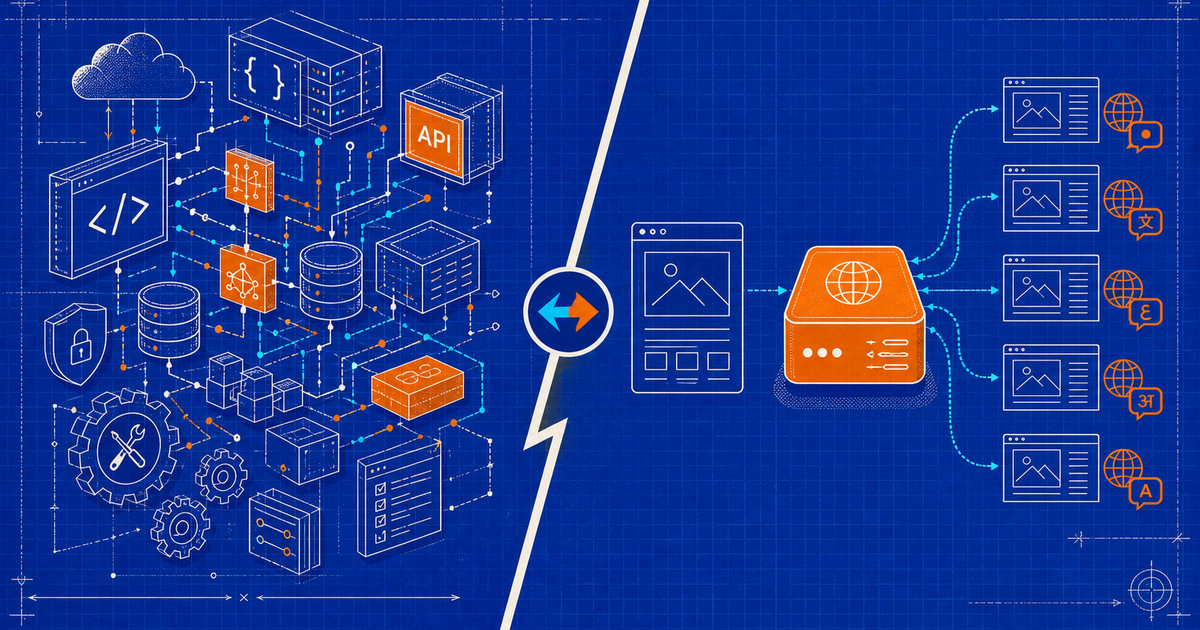
A real multilingual website must discover changing content, preserve HTML, protect variables, store approved edits, publish stable language URLs, generate international SEO signals, handle cache invalidation and give non-developers a safe review workflow. Translation is one service inside a much larger localization product.
So should your team build an AI website translation workflow or buy a plug-and-play localization SaaS? This guide breaks down the architecture, costs and decision criteria for 2026.
The short answer
Buy when website localization is necessary to grow the business but is not the product you sell. A no-code platform gets languages live faster, shifts maintenance to a specialist vendor and gives marketing teams direct control.
Build when translation behavior creates genuine product differentiation, your security or deployment requirements cannot be met by vendors, and you can fund a permanent localization engineering capability.
Use a hybrid model when you need custom business logic around a managed translation and delivery layer. This is often the best answer for a SaaS company with a unique application but a conventional marketing website.
What “build” actually includes
The translation API is the most visible component, but it is only one box in the system.
1. Content discovery and extraction
Your pipeline needs to find text in server-rendered HTML, client-side components, modals, forms, metadata, structured data, image alt text and dynamically loaded content. It must ignore code, IDs, customer data and elements explicitly excluded from translation.
For a frequently changing website, extraction must be continuous. A one-time crawler becomes outdated the moment marketing publishes a new page.
2. Segmentation and context
Models translate better when they know whether a string is a headline, CTA, navigation label or legal paragraph. The system must segment content without breaking tags, placeholders, numbers, variables or inline links.
“Book” can be a noun or an action. “Plan” can mean a pricing tier or a project. Sending isolated strings without context creates avoidable errors.
3. Translation orchestration
You need provider selection, prompts, language-pair rules, retries, rate limits, batching, timeouts and fallbacks. If you use several machine translation engines or LLMs, routing and evaluation become their own service.
4. Storage, versioning and reuse
Translations need stable IDs, source hashes, status values, edit history and a relation to the page where they appear. When a source sentence changes, the system must decide whether to invalidate, retranslate or preserve a human edit.
5. Review and publishing
Marketers and native reviewers need a searchable interface. Typical states include detected, translated, reviewed, published and outdated. Permissions, comments, bulk actions and rollback become important as soon as several people work together.
6. Delivery and performance
The visitor must receive the correct language without a slow page, visible flash or broken hydration. That requires caching, CDN delivery, language detection, browser preferences and a reliable language switcher.
7. Multilingual SEO
Translated content must be crawlable at stable language-specific URLs. Titles, descriptions, canonical tags, hreflang relationships, sitemaps and internal links must be correct for every locale.
If the translation only appears after a client-side click on one URL, search engines may never treat it as a separate localized page.
8. Quality assurance and operations
The production system needs monitoring, error logs, alerting, provider cost controls, privacy rules, translation exclusions, backups and tests across languages. Someone must own it after launch.
The real cost of a custom translation pipeline
The right calculation is total cost of ownership, not API price.
| Cost area | Custom build | Managed website translation SaaS |
|---|---|---|
| Initial engineering | Architecture, frontend, backend, dashboard and SEO work | Integration and configuration |
| Translation usage | API tokens or characters | Included or usage-based by plan |
| Infrastructure | Database, queues, cache, CDN and monitoring | Managed by vendor |
| QA tools | Must be built or integrated | Usually built in |
| SEO maintenance | Owned by engineering/SEO | Product feature |
| Provider changes | Migration work | Vendor responsibility |
| Ongoing ownership | Permanent developer and on-call time | Subscription plus content review |
| Time to first language | Weeks or months | Minutes or days |
Imagine a small internal build requiring eight engineer-weeks. At a fully loaded cost of €8,000 to €12,000 per engineer-month, the first version may already represent €16,000 to €24,000, before design, QA, security and ongoing maintenance.
A €19 or €49 monthly localization plan is not automatically better—requirements matter—but API calls are rarely the largest line item in a custom system.
Hidden costs teams underestimate
Content changes
Source copy is not static. A tiny wording change must invalidate the right translations without discarding unrelated human corrections.
Layout expansion
German or French labels may be much longer than English. Arabic and Hebrew require right-to-left testing. Japanese line breaks and font fallback change the visual result. Translation quality cannot be evaluated outside the page.
SEO edge cases
Non-reciprocal hreflang, wrong canonicals and language pages linked to redirects can remove entire locales from search results.
Model drift
Prompts, providers and model versions change. The team needs regression tests for terminology, tone, HTML preservation and high-value pages.
Organizational adoption
A technically elegant API is useless if marketing still sends spreadsheets to engineering. Review, approval and publishing must fit the people who actually own the content.
When building is the right decision
Build when several of these are true:
- localization behavior is a core product capability, not a supporting website function;
- you must run translation inside a private network or a specific data boundary;
- your content format or rendering architecture is genuinely unsupported;
- you have millions of highly specialized interactions where vendor economics do not work;
- you need unique model routing or linguistic automation that creates competitive advantage;
- a dedicated engineering team will own the system for years;
- you accept a longer launch in exchange for control.
Even then, build the differentiating layer only. Commodity components such as machine translation, CDN delivery or a TMS can still be purchased.
When buying is the better decision
Buy when:
- the goal is to make an existing website multilingual quickly;
- marketing publishes content frequently;
- you need Webflow, WordPress, Shopify, React or custom-site compatibility;
- non-developers must edit and publish translations;
- multilingual SEO is a requirement;
- your team wants predictable operating cost;
- engineering has higher-value roadmap work;
- you want to test international demand before investing heavily.
A managed platform converts a software project into an operational workflow. The team can spend its time selecting markets, improving messages and measuring conversion rather than maintaining translation infrastructure.
Why LingoJS changes the calculation
LingoJS is designed for the common case: a company already has a website it likes and wants to localize it without rebuilding the stack.
You add one lightweight snippet or a native integration. LingoJS detects website content, creates contextual AI translations and gives the team a central place to review, edit and publish. Localized pages, metadata and language routing support international SEO, while cached global delivery avoids turning translation into an application performance project.
Paid plans include unlimited translated words and start at €19 per month. That makes the buy side of the equation especially attractive for content-heavy SaaS sites, agencies and small businesses.
LingoJS does not remove every localization task. Your team should still choose target markets, review critical pages and test the experience. It removes the infrastructure work that does not differentiate your business.
Explore LingoJS for SaaS website localization and read our multilingual SEO guide.
A practical decision scorecard
Give each statement one point.
Points for buying
- We need a first target language live in under one month.
- Our source site changes every week.
- Marketing should control translations.
- We need international SEO without building it.
- We support more than one CMS or web framework.
- Translation infrastructure is not a product differentiator.
- We cannot dedicate an engineer to long-term maintenance.
Points for building
- Localization logic is central to our paid product.
- We have strict requirements no vendor can satisfy.
- We need custom linguistic behavior that creates measurable advantage.
- We already operate global content infrastructure.
- A permanent team and budget are assigned.
- We can tolerate a longer time to market.
If buying wins by three points or more, start with a managed platform. If building wins clearly, write a formal product brief and budget the operating team—not only the prototype.
The hybrid architecture
Build versus buy is not binary. A strong hybrid model can look like this:
- Use your CMS as the content source.
- Connect the public website to a managed localization layer.
- Add custom API logic only for proprietary application content.
- Keep human review on pricing, legal, checkout and brand pages.
- Share terminology and quality rules across both flows.
- Measure SEO, engagement and conversion by language.
This architecture preserves control where it matters and avoids recreating commodity website plumbing.
Frequently asked questions
How long does it take to build a website translation system?
A demo can take days. A production system with extraction, storage, editing, delivery, SEO, QA and monitoring generally takes weeks or months and requires ongoing maintenance.
Is using a translation API cheaper than a localization SaaS?
The raw API bill may be lower, but it excludes engineering, infrastructure, review tools, SEO and operations. Calculate total cost of ownership.
Can we start with no-code and build later?
Yes. This is a sensible way to validate languages and markets before funding custom infrastructure. Keep an export and architecture plan if long-term portability is important.
What should a SaaS company localize first?
Start with the homepage, product pages, pricing, signup, onboarding and high-intent SEO pages. Review these manually before translating the entire long tail.
Conclusion
If website translation is not your core product, buying is usually the faster and less risky decision. Custom infrastructure makes sense when it creates unique business value and has a permanent team behind it.
For everyone else, test the market before building the machinery. Start LingoJS free for 30 days, connect your current site and compare the result with your custom-build estimate.